
Care and Maintenance
Every piece we make falls into one of two groups, and they are cared for completely differently. If it was made to be cut on, it is a food surface. If it was made to be looked at, it is a sealed surface. We never blur the line between them, and the reason why is further down this page.
Food Surfaces
Cutting boards, charcuterie boards, and serving trays. These are made from bamboo, maple, walnut, or cherry and finished with a butcher block oil. That oil conditions the wood rather than sealing it, which is why these pieces need occasional attention and why they are safe to cut on.
Washing
Hand wash with warm water and mild dish soap, then dry it right away with a towel. Stand it on edge to finish drying rather than laying it flat, so both faces dry at the same rate.
Never do these: no dishwasher, no soaking or leaving it in a sink, no leaving it flat on a wet counter. Every warped board we have ever seen came from one of those three.
Oiling
Re-oil whenever the surface starts to look dry or pale, usually every three to four weeks with regular use and more often through winter when indoor heat pulls moisture out of the wood.
Use a food-grade mineral oil or a butcher block oil. Apply a generous coat, let it sit for half an hour, and wipe off what has not soaked in. An oil and beeswax blend gives better water resistance if you want it.
Never use olive oil, vegetable oil, or any cooking oil. They go rancid in the grain, and the smell does not come out.
Stains and Odors
Scrub with coarse salt and half a lemon, then rinse and dry. For stubborn stains, use a paste of baking soda and water. For onion or garlic smell, use the salt and lemon treatment again.
After Raw Meat
Wash with hot soapy water, then sanitize with a solution of one tablespoon of unscented bleach per gallon of water, rinse, and dry immediately.
Protecting the Design
The design is burned into the grain rather than sitting on the surface, so it cannot peel or wash off. It will deepen slightly over the first year. Do not scour it with steel wool or an abrasive pad, which will not remove the burn but will scratch the surrounding wood unevenly.
Notes on Different Types of Wood
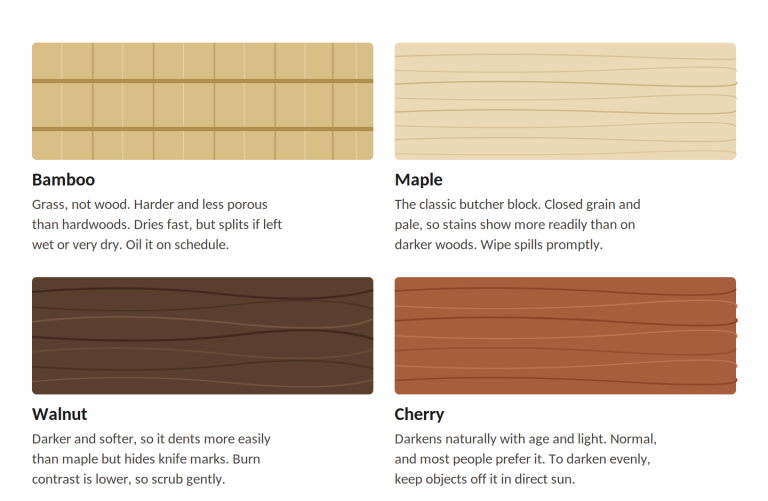
Bamboo is technically a grass and is harder and less porous than the hardwoods. It dries quickly, which is good, but it can split if it is left wet or allowed to get very dry. Oil it on schedule.
Maple is the classic butcher block wood. It’s closed-grain and pale, so stains show more readily than on darker woods. Wipe spills promptly.
Walnut is darker and a little softer, so it dents more easily than maple but hides knife marks better. The burn contrast is lower against dark wood, so avoid aggressive scrubbing that lightens the surrounding grain.
Cherry darkens naturally with age and light exposure. This is normal, and most people prefer it. To keep it darkening evenly, don’t leave objects sitting on it in direct sun.
Not All Wood Types Work For Cutting Boards
We use oak, plywood, and MDF, and we use them often. None of them will ever leave our shop as a food surface. Here is the reasoning, because we would rather you understood it than simply took our word for it.
Oak
Oak is ring porous, which means the vessels that carried water up the living tree are large enough to see and, in red oak, large enough to blow air through end to end. Those open pores hold moisture, food residue, and bacteria below the surface where washing does not reach and where oiling cannot seal them. Maple, walnut, and cherry are closed grain and do not have this problem, which is why they have been the butcher block woods for two centuries.
There is a real exception worth knowing. White oak grows tyloses, cellular plugs that block those vessels, which is why white oak holds whiskey in a barrel and red oak cannot. White oak is defensible for food use in a way red oak never is. We still do not use it for boards, because unless you mill your own stock, you cannot always be certain which oak you have, and a guess is not a standard we are willing to apply to something you will eat off.
Plywood & MDF
Plywood is thin veneers bonded together with adhesive. Two problems, and both are structural rather than fixable. The adhesives used in ordinary construction plywood are not rated for food contact. And the face veneer is often under a millimeter thick, so the first real knife cut goes through the wood and into the glue line beneath it. There is no sanding that back out, because there is nothing underneath to sand into.
MDF is wood fiber compressed with a resin binder. It has no grain, so there is nothing for oil to penetrate and nothing to resurface. It absorbs water on contact and swells permanently, and the binder is not a food-contact material. A knife scores it open, and the damage is done.
The short version: a finish can protect a surface, but it cannot change what the material underneath it is. If we would not eat off it ourselves, we do not sell it as something you can eat off.
Sealed Surfaces
Signs, wall art, decor pieces, and anything made from oak, plywood, or MDF. These are finished with a protective film rather than an oil.
These are not food-safe and are not meant to be cut on. See the section above for why that is not a disclaimer but a material fact.
Cleaning
Dust with a dry or barely damp cloth. Nothing more is needed.
Never do these: no soaking, no running water, no submerging, no abrasive pads, no ammonia-based cleaners, no bleach, no all-purpose sprays — all of which will cloud or strip the finish.
Plywood & MDF
Keep water away from the edges, where the core is exposed. Swelling at an edge is permanent. If an edge gets wet, wipe it immediately.
Where To Hang It
Out of direct sunlight, which fades the contrast in the burn over time and can yellow the finish. Away from steady humidity swings, so not directly above a stove, not in a bathroom, and not in an unheated garage or porch unless the piece was finished for outdoor use.
Long Term
Indoor pieces should not need refinishing. If a piece looks dull after several years, a light wipe with a slightly damp cloth and a thorough dry usually brings it back.